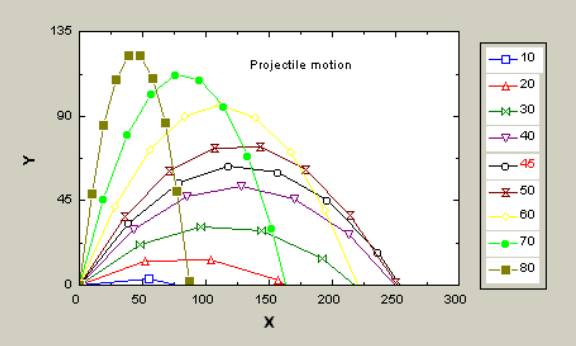
"A baseball thrown from the
outfield, a golf ball or a thrown football all will follow a trajectory (path) that
has horizontal as well as vertical components. "
"If we neglect the air friction
(drag) on the ball, the velocity in the horizontal direction remains
constant."
"The velocity in the vertical
direction varies because the ball is free falling with the acceleration of
gravity g (9.81 meters per second). The acceleration of gravity is always
directed toward the earth. "
"Displacement :"
"X=Xo+Vox*t "
"Y=Yo+Voy-(1/2)*g*t^2 "
"Velocity as a function of time
(t):"
"Vx=Vox "
"Vy=Voy-g*t "
"Here we see that the velocity is
a combination of constant motion in the x-direction and a constantly
accelerating motion in the y-direction. "
"All baseball players, golfers and
football players know that the effects of the wind are not negligible, but for
now we ill ignore these effects and look at the basic causes of the motion.
"
"This keeps the mathematics
simpler. In your junior and senior year you will deal with the effects of drag
on motion of bodies. "
"Initial velocity of the
projectile is: "
"Vox=Vo*cos(theta) "
"Voy=Vo*sin(theta) "
"We can assume that the projectile starts at the origin of the
coordinate system (x=0,y=0). Then, the position of the projectile as a function
of time is given by the two equations: "
"X=Vox*t "
"Y=Voy*t-(1/2)*g*t^2 "
"The range is the horizontal displacement
when the projectile returns to ground level (y=0). The range can be calculated
from the formula: "
"R=(Vo^2*sin(2*theta))/g "
"Use the EES max/min function to
prove that the maximum range is obtained when the projectile motion is
initiated at a 45
degree angle."
"Given:"
Xo=0
Yo=0
Vo=50 "m/s"
g=9.81 "acceleration
of gravity"
"Equations:"
X=Xo+Vox*t;
Y=Yo+Voy*t-(1/2)*g*t^2
Vx=Vox
Vy=Voy-g*t
Vox=Vo*cos(theta)
Voy=Vo*sin(theta)
R=(Vo^2*sin(2*theta))/g